Father Joel E. Tabora, SJ, who served as President of Ateneo de Davao University from 2011 to 2023 and who helped articulate the university’s mission as deeply rooted in the Mindanao context, once described university life in terms of three existential spaces: the familial, the horizontal, and the vertical. His leadership helped shaped Ateneo de Davao as a Catholic, Jesuit, and Filipino university with a “Mindanao finality,” giving these categories both philosophical grounding and practical resonance. Over time, I found that what he offered was not merely an administrative framework but a way of understanding how we inhabit this place: how we work, how we gather, how we build community, and how we attend to the deeper movements of our interior lives. These dimensions became especially vivid to me in my encounters with the University Chapel of Our Lady of the Assumption, a space where these three ways of being—familial, horizontal, and vertical—seem to converge most powerfully.
The familial space reveals itself in the quiet structures of care built into the university’s life. These are found in the housing project in Catalunan, in the scholarship benefits for employees’ children, and in the many programs that allow families to build stability. These are not dramatic initiatives, but they cultivate a sense of belonging and dignity. They remind us that a university is not only a space of intellect but a space where families live, hope, and anchor themselves in daily life.
The horizontal space forms the landscape of our everyday work in the unviersity. Classrooms, laboratories, hallways, offices, and auditoriums provide the places where we plan, study, discuss, negotiate, and collaborate. These spaces call for action and productivity. They hold the weight of responsibilities, deadlines, and conversations that shape both our immediate decisions and our long-term commitments. They represent the mission of the university in its most tangible form: knowledge transmitted, ideas examined, and community life unfolding in ordinary but essential ways.
The vertical space, however, interrupts these routines. It is not concerned with tasks or outputs. It asks different questions. It invites presence rather than productivity. Nowhere is this more visible than in the University Chapel of Our Lady of the Assumption. It is a space that shifts our posture inward and upward, prompting reflection that the horizontal spaces seldom allow.
Entering the chapel feels like walking into a curated dialogue between art, faith, culture, and architecture. The space does not announce itself loudly. Its impact emerges slowly, through textures, colors, symbols, and the way light inhabits its surfaces.
The first artwork we encounter is Mark Tolentino’s painting of Mary as Sitti Maryam. This portrayal immediately sets the tone for what the chapel intends to be. Her gentle expression, rendered in warm earthy colors, carries a disarming simplicity. Tolentino avoids dramatization and instead offers a figure who serves as a bridge between Christian and Muslim traditions. The light softly touching her face suggests humility, while her posture conveys welcome. This painting prepares the visitor to understand that the chapel is not merely a Catholic space; it is a Mindanaoan space where faith traditions converse without collapsing into each other. The painting begins a subtle reorientation of the senses, encouraging an openness to the cultural translations that follow.
Tolentino’s murals deepen this encounter. The first, depicting Jesus teaching in a Tausug langgal, invites the viewer to consider how sacred narratives might breathe anew in local textures. The langgal is rendered with thoughtful attention to its architecture. The bamboo supports and wooden slats are depicted with enough detail to suggest familiarity without overwhelming the scene. The woven baluy talang beneath Jesus’ feet grounds the moment in the daily life of the community. This simple mat becomes a theological anchor. By placing Jesus in a Mindanaoan setting, the mural draws the Gospel message into the lived realities of the region. The proclamation from Luke about liberation and healing takes on new immediacy. The figures gathered around Jesus display a range of reactions—curiosity, doubt, resistance, hope. Tolentino paints each with careful distinction, reminding the viewer that prophecy is always addressed to real people rooted in their own histories and struggles.
The second mural, which portrays Jesus’ encounter with the Samaritan woman, draws the viewer into a quieter reflection. The composition narrows, focusing on the moment when water is given and received. The woman’s attire, painted in traditional Tausug clothing, highlights dignity and agency. The bamboo dagtung she carries is textured with delicate shading, making its surface appear tactile and familiar. Jesus receives the water in a ba’ung, a coconut shell, which subtly reframes the biblical encounter through everyday materials familiar to Mindanao. The act of giving water becomes a gesture of cultural humility, a small but powerful symbol of shared humanity. The triple parasol behind them suggests nobility, yet its presence is understated. It frames the figures without dominating them. It is an encounter rendered with restraint, allowing the viewer to sit with the quiet weight of dialogue.
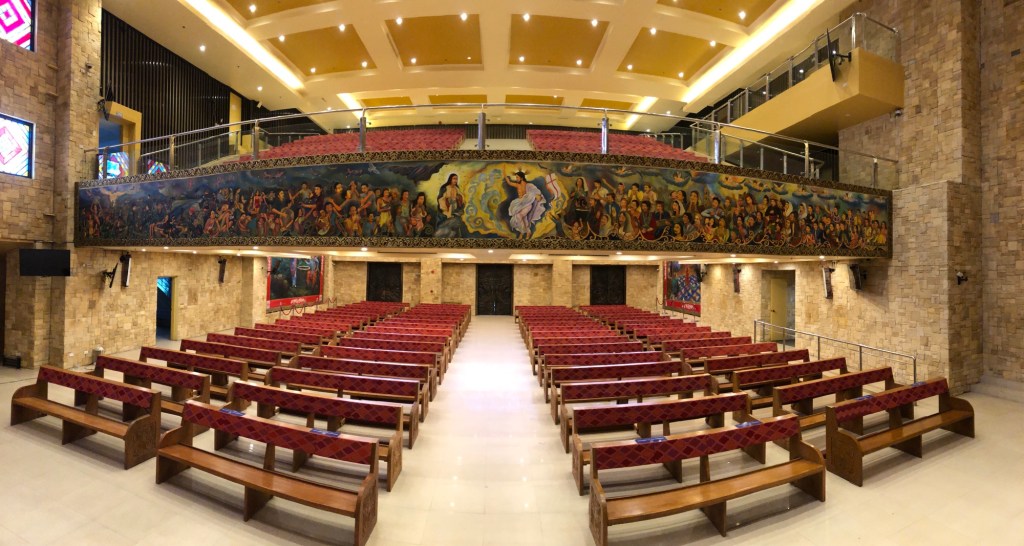
Suspended high above the central beam is Bong Espinosa’s immense Salubong painting. Its length alone commands movement; one cannot take it in without allowing the eyes to travel. This mural brings dynamism into the chapel. It depicts the meeting of the Risen Christ and the Sorrowing Mother, a moment drawn from the Fourth Week of the Spiritual Exercises. The horizontal sweep of the canvas draws two processions toward one another. Christ’s procession is filled with vitality, with figures dressed in the traditional garments of Mindanao’s many indigenous groups. Their faces are expressive, their colors vibrant, their movement energetic. Mary’s procession carries a different emotional weight. The figures around her appear subdued, painted in deeper hues of blue and purple, capturing the heaviness of grief. When the two processions meet, neither sorrow nor joy is erased. Instead, the encounter creates a kind of rupture where transformation becomes possible. Light begins to emerge at the center, not dramatically but gently, suggesting that resurrection is not a spectacle but a steady illumination entering human experience.
Beyond the paintings, the chapel’s materials tell their own story. The Cebu yellow sandstone that lines the interior absorbs light in a way that softens the entire atmosphere. Its varied tones evoke both earth and warmth. The carvings and rough textures remind the visitor that prayer, like stone, is shaped over time. The sandstone stands in contrast to the steel and glass of the surrounding buildings, offering a sense of groundedness that feels both ancient and immediate.
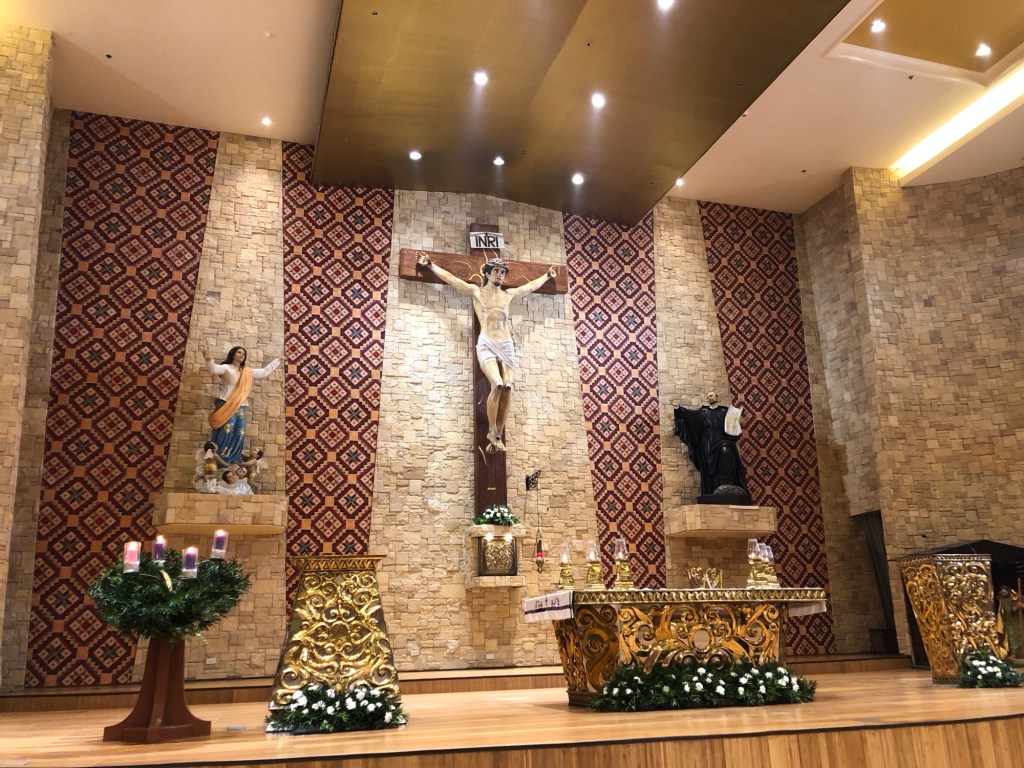
The Yakan fabric mosaics woven by the family of Krishnan Kin Nasser Ilul bring texture into the architectural field. Their geometric patterns, interpreted in stone and glass, appear throughout the chapel. They create continuity, visually linking the walls, stained glass windows, and pews made by Timburana. The patterns do not shout for attention; rather, they guide the eye gently, reminding the viewer that indigenous culture is not merely decorative but integral to the identity of this sacred space.
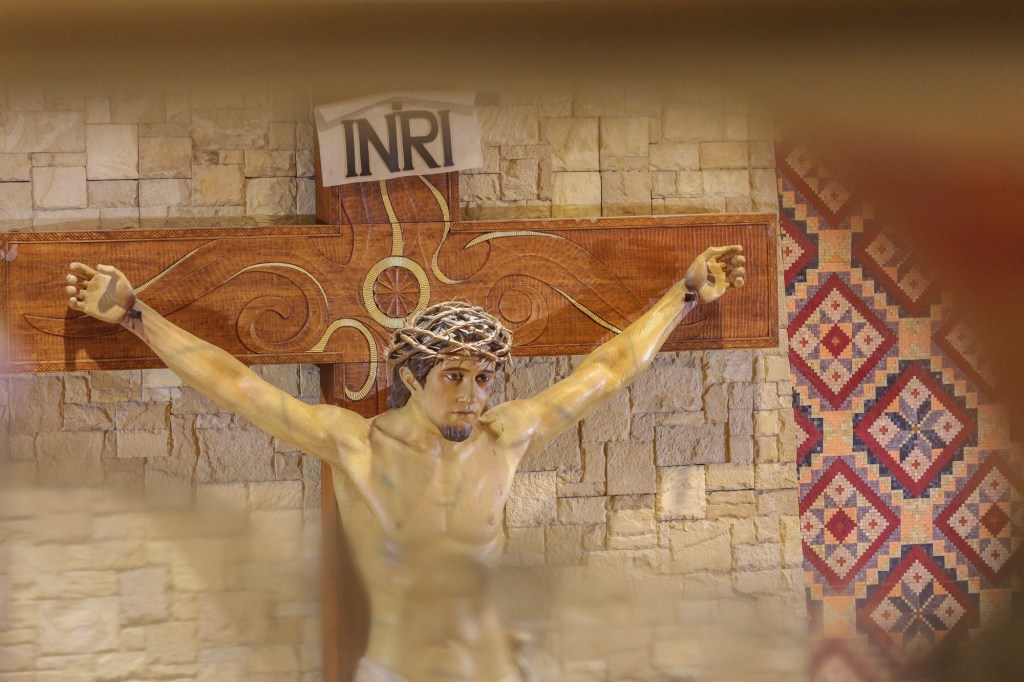
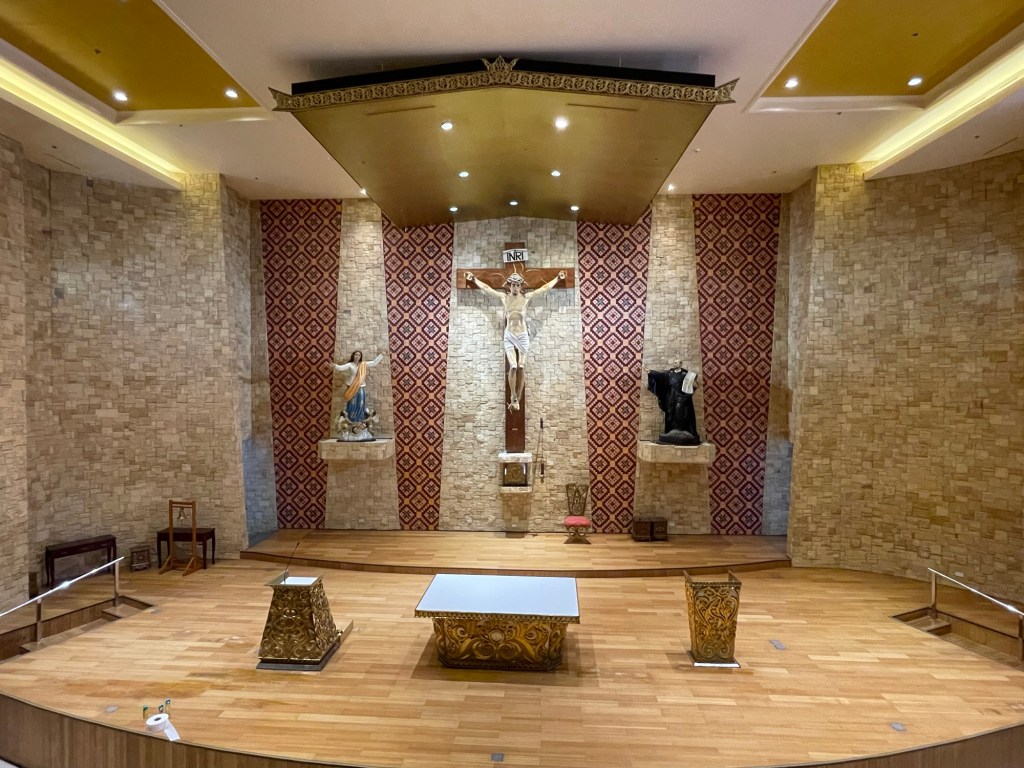
At the visual center stands the crucifix carved by Paloy Cagayat. Jesus is rendered in batikuling wood with his eyes open, a choice that shifts the entire emotional tone of the sculpture. His gaze does not accuse or retreat. It meets the viewer with a quiet steadiness that feels almost conversational. The decision to carve him with open eyes transforms the crucifix into an invitation for reflection. It evokes the Ignatian questions that ask not for guilt but for honesty: What have I done? What am I doing? What ought I do? The crucifix is neither overly stylized nor overly realistic. Its restraint is what gives it depth.
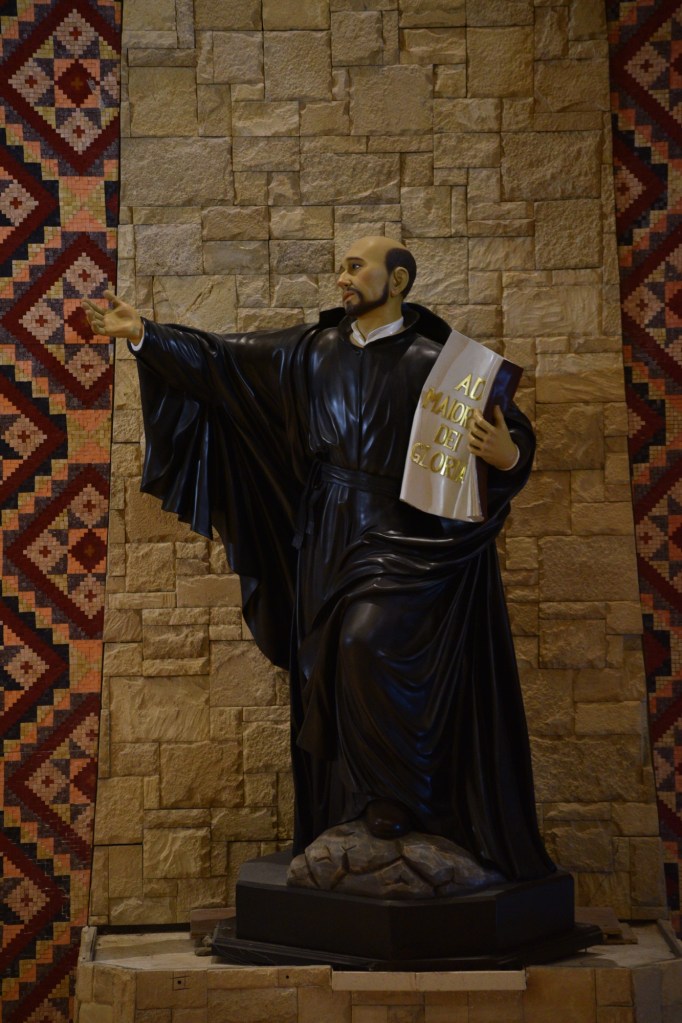
Flanking the crucifix are two statues by Cagayat: St. Ignatius and Our Lady of the Assumption, the latter wearing Maranaw-inspired attire. Their presence frames the central figure of Christ and grounds the chapel in Ignatian spirituality. Mary’s posture, gentle and attentive, mirrors the invitation of her son. Ignatius stands with a disposition of readiness, reflecting the spiritual stance at the heart of his exercises. Together, these statues create a kind of quiet choreography of attention, guiding visitors back toward the crucified and risen Christ.
The brasswork by Sajid Imao gives the chapel its distinctive Mindanaoan character. The okir patterns, typical of Maranaw artistry, appear on the altar, the ambo, the tabernacle, and the towering doors. The curves and flourishes of okir evoke motion, and when rendered in brass, they interact with light in shifting, subtle ways. Depending on the time of day, the patterns seem to move. The brass carries both weight and luminosity. It holds the cultural heritage of Mindanao while serving liturgical purpose. The doors, heavy yet intricately carved, turn the act of entering the chapel into a symbolic crossing, a passage shaped by peace, unity, and connection to place.
The chapel, with all its elements, becomes the clearest expression of the vertical dimension of university life. It calls for pause and interiority, qualities that the horizontal spaces rarely afford. Yet it does not isolate itself from those spaces. Instead, it speaks back to them. It reminds the visitor that the work done in classrooms and offices gains depth when seen through the lens of reflection and purpose. The chapel does not resolve the tension between action and contemplation, but it clarifies it. It encourages a relationship between the two.
When I sit in the chapel, I often sense that formation in a university is not limited to academic disciplines or administrative processes. It emerges in the interplay between the spaces we inhabit. The familial grounds us, the horizontal drives us, and the vertical reorients us. The chapel, through its art and architecture, becomes a teacher that does not use words. It encourages presence, patience, and attention. It invites me to look again, more slowly, more honestly.
In this way, the University Chapel of Our Lady of the Assumption becomes part of my own story and the story of the community. It gathers art, culture, theology, and daily life into a single space that continually asks: who are we becoming, and toward what purpose? It is a space where faith is not imposed but encountered, where culture is not ornament but language, and where reflection becomes not an escape from work but its deepest partner.

 Being Here, Now.
Leave a comment